
Indian banks and non-banking financial companies (NBFCs) are undertaking a comprehensive review and reset of their engagement terms with fintech firms, driven by the Reserve Bank of India's (RBI) draft Guidance on Regulatory Expectations for Data Governance and the stringent compliance requirements of the Digital Personal Data Protection (DPDP) Act, 2023, and its 2025 Rules.

India's markets regulator Sebi has launched 'Demat 2.0', a pilot project for tokenisation of corporate bonds, enabling atomic settlement through integration with RBI's wholesale CBDC. This new market infrastructure uses Distributed Ledger Technology (DLT) to make bond issuance, trading, and settlement faster and more efficient. India is the first country to issue corporate bonds natively on a distributed ledger with central bank digital currency settlement. Additionally, RBI Governor announced new UPI innovations: 'Tap & Pay' for faster POS transactions and MyUPI, an AI-powered customer support solution.

India's wholesale price index (WPI) inflation surged to 9.68 per cent in May, up from 8.26 per cent in April, primarily due to significant increases in the prices of fuel and power, manufactured goods, and food items.

The Congress party has criticised the government's new 0.4% charge on UPI transactions above Rs 2,000 for merchants, terming it a "Modi tax". Opposition leaders, including Rahul Gandhi and Mallikarjun Kharge, allege that this move will ultimately burden consumers through price hikes and accuse the government of succumbing to American pressure to dilute India's zero-MDR policy. The government states the charge will support banks and fintechs.

India's wholesale price inflation (WPI) increased to 9.87 per cent in June, up from 9.68 per cent in May, primarily due to significant price increases in non-food and food products, with food inflation alone rising to 5.49 per cent.

Bank credit to industry in India surged by 20 per cent year-on-year in July, significantly accelerating from the previous year, driven by strong expansion in sectors like engineering, gems and jewellery, and petroleum-related industries, according to the Reserve Bank of India (RBI). However, growth in gold loans, while still expanding, saw a sharp moderation.

The central government has introduced a 0.4 per cent fee on UPI transactions exceeding Rs 2,000, prompting traders' associations to advocate for cash payments to avoid additional costs on digital payments. This move ends the zero-Merchant Discount Rate (MDR) regime, with traders expressing concerns about operating on tight margins and the potential for increased charges.

The Congress party has criticised the Modi government over a notification regarding UPI transactions, alleging it paves the way for imposing fees, especially on transactions above Rs 2,000. Rahul Gandhi claimed the government is surrendering to American pressure, while Mallikarjun Kharge highlighted the potential burden on common citizens amidst inflation. The government's notification prohibits charges on UPI transactions up to Rs 2,000 but remains silent on higher amounts, sparking fears of a "Digital Payments Tax."

India's wholesale price inflation surged to 3.88 per cent in March, marking the fifth consecutive monthly increase, primarily driven by a sharp rise in crude petroleum, natural gas, and manufactured items amidst the West Asia crisis.

India's statistics ministry has defended its newly released economic growth estimates, stating that revisions to last year's GDP and the divergence between different price measures reflect updated data and estimation techniques rather than an attempt to artificially boost headline growth.

Analysts predict that the US-Iran geopolitical conflict, upcoming quarterly earnings announcements, and fluctuations in crude oil prices will be the primary drivers of investor sentiment in the Indian equity markets.

The National Payments Corporation of India (NPCI) is set to consider linking the ATM interchange fee to the Wholesale Price Index (WPI), alongside a potential hike from the current 19 to 21-22, which could impact customer charges for transactions beyond the free limit.

Bank of Baroda economists project India's GDP to grow 6.5-6.8 per cent in FY27 but warn that the fiscal deficit could overshoot the budgeted 4.3 per cent target, potentially reaching 4.7-4.8 per cent of GDP due to subsidy overruns, excise duty cuts, and oil marketing company losses.
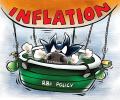
The Reserve Bank of India has increased its retail inflation projection for 2026-27 to 5.1 per cent, up from an earlier estimate of 4.6 per cent. This revision is primarily attributed to mounting input costs, driven by the pass-through of higher global energy prices to domestic petrol and diesel rates, which have seen significant increases since May.

Standard Chartered Bank on Friday launched private banking operations in the country with focus on entrepreneurs and senior executives with investible wealth of over 1 million dollars (Rs 4.5 crore).

Wholesale price inflation (WPI) fell to (-) 1 .21 per cent in October, driven by a decline in prices of food articles like pulses and vegetables, as well as lower fuel and manufactured items' prices, government data showed on Friday.

'The real shock is going to be from a deficient monsoon.'

'Once the currency goes out of the hand, then possibly your major challenge is that it will not come back.'

West Asia conflict triggers sharp sell-off in Indian markets, with realty, banking and auto stocks leading losses amid energy shock fears.

Kotak Mahindra Bank on Tuesday announced that its joint managing director K V S Manian, a veteran at the private sector lender, has stepped down with immediate effect. Manian, who had been with the lender for nearly three decades, was elevated in a management rejig in January.

Wholesale price inflation dropped to 0.85 per cent in April as prices of food articles, manufactured products, and fuel eased, government data showed on Wednesday. WPI-based inflation was 2.05 per cent in March. It was 1.19 per cent in April last year.
HDFC Bank has reshuffled the portfolios of its senior management team. This is the first major rejig after the amalgamation of HDFC Ltd on July 1. "The runway for our growth is large. This change is being done to bring in a very sharp focus on leveraging what we have built and for enhanced execution," said Sashidhar Jagdishan, managing director and chief executive of HDFC Bank, explaining the reason for this overhaul.

Foreign banks set the template in consumer banking in its infancy, but have almost vacated this booming space.

There are hopes of a turnaround in overall corporate earnings after six quarters of single digit growth.

Wholesale price inflation rose to a 4-month high of 2.36 per cent in October as prices of food items, especially vegetables, and manufactured goods turned dearer, as per the government data released on Thursday. The wholesale price index (WPI) based inflation was 1.84 per cent in September 2024. It was (-) 0.26 per cent in October, last year.

Reserve Bank Governor Sanjay Malhotra on Wednesday exhorted the fledgling fintech ecosystem to focus on the underserved sections of the society to deepen financial inclusion. Speaking at the annual Global Fintech Fest in Mumbai, Malhotra accepted that serving the "privileged" will be a lucrative business, but urged the smaller companies to focus on the underserved.

Wholesale inflation rate declined marginally to 0.2 per cent in February compared to 0.27 per cent in the preceding month despite a slight uptick in the food basket. The Wholesale Price Index (WPI)-based inflation was in the negative zone from April to October and had turned positive in November at 0.26 per cent. The inflation in February 2023 was 3.85 per cent.

The wholesale price index (WPI)-based inflation rose in December at 0.73 per cent mainly due to a sharp rise in food prices. The WPI inflation was in the negative zone from April to October and had turned positive in November at 0.26 per cent.
The wholesale price index (WPI)-based inflation eased in January to 0.27 per cent, mainly due to moderation in prices of food items. WPI inflation was at 0.73 per cent in December 2023. The WPI inflation was in the negative zone from April to October and had turned positive in November at 0.39 per cent.
US bank Citigroup on Wednesday announced the sale of its Indian consumer banking businesses, including credit cards, retail banking, wealth management and consumer loans, to private lender Axis Bank for Rs 12,325 crore, as part of its plans to exit retail operations in 13 markets.

Wholesale inflation fell to a 4-month low of 1.31 per cent in August due to a decline in prices of vegetables and fuel, even though onion and potato prices spiked, according to official data released on Tuesday. Wholesale price index-based inflation fell for the second straight month in August after it hit a high of 3.43 per cent in May. Inflation in July was 2.04 per cent. In August last year, WPI inflation was (-) 0.46 per cent.

In August, RBI allowed 11 business houses to start a payments bank.
Wholesale inflation fell to a 3-month low of 2.04 per cent in July on decline in prices of food items especially vegetables, government data released on Wednesday showed. The decline in wholesale price index (WPI) based inflation in July came after it rose for four months in a row till June, when it was 3.36 per cent. It was (-) 1.23 per cent in July last year. In April wholesale inflation stood at 1.19 per cent.

Among Sensex firms, Eternal, Infosys, Asian Paints, HDFC Bank, Bajaj Finserv and Titan were the major gainers. However, Tata Steel, Tech Mahindra, Adani Ports and Bharat Electronics were among the laggards.

Wholesale price-based inflation remained in the negative territory for the fifth straight month in August at (-)0.52 per cent, but prices of food articles and fuel showed an uptick. The wholesale price index (WPI) based inflation rate has been in the negative since April and was (-)1.36 per cent in July. In August last year it was 12.48 per cent. Inflation in food articles remained in double digit at 10.60 per cent in August, lower than 14.25 per cent in July.

Wholesale price-based inflation rose to an eight-month high of 0.26 per cent in November, driven by a sharp jump in food prices, especially onion and vegetables. The WPI inflation was in the negative or deflationary zone for the past seven months since April and was at (-)0.52 per cent in October. The last positive WPI inflation was recorded in March at 1.41 per cent.

'Listing of scaled Indian subsidiaries of multinational corporations as well as of Indian conglomerates continues to remain a key theme for IPOs in India.'

Wholesale price inflation remained in the negative territory for the fourth month in a row in July at (-)1.36 per cent, even though prices of food items, especially vegetables, skyrocketed. The inflation, however, has inched up from (-)4.12 per cent recorded in June fuelled by 62.12 per cent rise in vegetable prices. In July last year, wholesale price index (WPI) was 14.07 per cent.

Uncertainties over the impact of the United States' (US') tariffs on India, along with the ongoing transmission of past rate cuts, prompted the members of the Reserve Bank of India's Monetary Policy Committee (MPC) to maintain the status quo during the August meeting, the minutes showed. While some of the external members highlighted their concern over growth, the internal members cited the one-year headline inflation rate overshooting the 4 per cent target.

Police on Monday detained a close associate of cleric and Ittehad-e-Millat Council chief Tauqeer Raza Khan in connection with the recent violence in Bareilly during a protest in support of the 'I Love Muhammad' campaign, officials said.
